Four agent standards have a new home. Portability still needs proof.
The Agentic AI Foundation added four projects this week. Shared governance can reduce integration work. It does not prove a whole workflow moves unchanged.
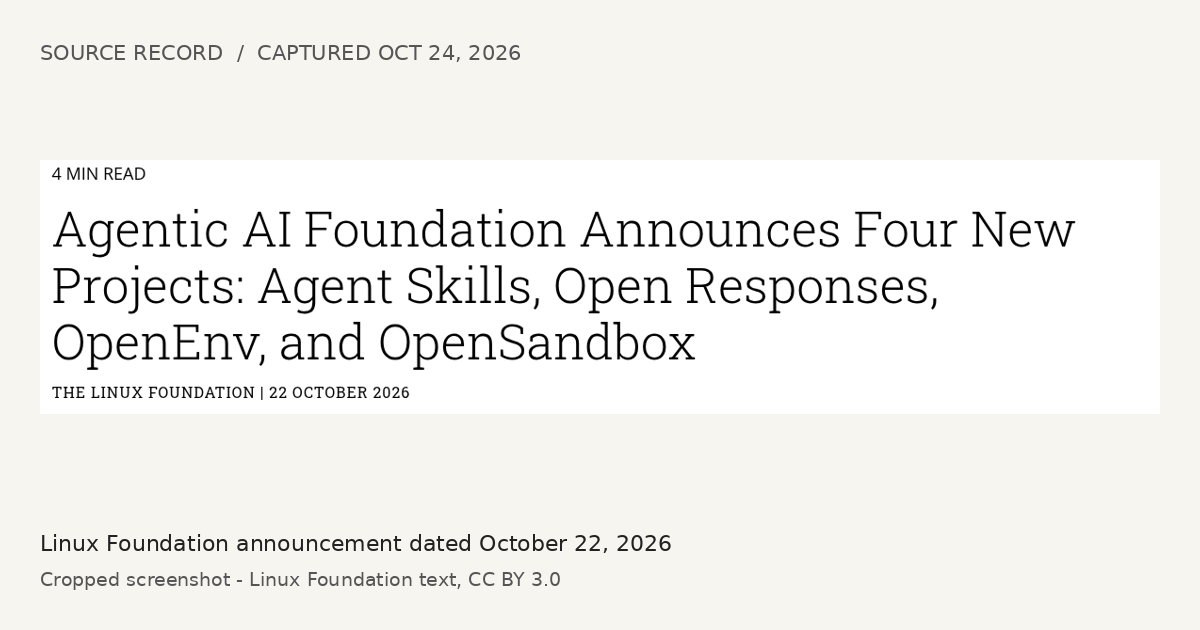
Source record: Linux Foundation announcement dated October 22, 2026, captured by GigSoul on October 24, 2026. Cropped screenshot with framing added. Text: The Linux Foundation, CC BY 3.0 under its site terms. No endorsement implied.
Four companies put four different pieces of the agent stack into the same foundation this week. The paperwork now has a common home. The work of making those pieces behave together has not disappeared.
On October 22, the Agentic AI Foundation announced that it was adding Agent Skills from Anthropic, Open Responses from OpenAI, OpenEnv from Hugging Face and OpenSandbox from Alibaba. The foundation says the additions bring its total to 10 hosted projects.
For an operator, the interesting part is where the seams fall. These projects address different questions: what an agent knows how to do, how an application talks to a model, how training environments connect, and where code runs. A shared home for those contracts matters. It is not a certificate that an entire agent can move between providers unchanged.
One announcement, four separate contracts
The foundation describes Agent Skills as a reusable format for specialized instructions and resources. Open Responses defines a common model interface. OpenEnv connects reinforcement-learning environments through a containerized service. OpenSandbox supplies interfaces for isolated execution. Those are the foundation's descriptions, not results from a GigSoul integration test.
That separation is useful. A team replacing its model provider is not necessarily replacing its training environment or its execution platform. Treating all four as one portability switch would hide the decisions that still belong to the team running the application.
A common request is a start
AWS's announcement makes the case for Open Responses in practical terms: a shared request format, streaming events and tool-use patterns can reduce the amount of provider-specific code an application needs. AWS also says Amazon Bedrock already supports the Responses API across models from multiple providers. That is a provider's account of its implementation, not an independent migration benchmark.
The specification itself is more useful than a slogan about switching. It sets requirements for responses, errors and the events that finish a stream. A client needs to know whether a request completed, failed or remained incomplete. Receiving text is not the same thing as receiving a completed result.
There is an acceptance-test page, too. It lists checks for basic responses, streaming, tool calling, image input and multi-turn conversations, alongside separate WebSocket checks. We did not run those tests. Their existence gives buyers something concrete to ask about: which tests did your chosen endpoint pass, and which parts of your workflow remain outside those checks?
The environment still has a boundary
Alibaba's OpenSandbox project explanation draws another useful line. Its common lifecycle interface can work with Docker or Kubernetes, while those runtimes remain different systems. A common way to request an environment does not make the environments identical.
That is the right level of claim. An interface can make replacement less expensive without making every replacement equivalent. An operator still needs to check what happens to files, running work and results when the underlying environment changes. Those are verification questions, not failures established by this announcement.
Governance is progress. Receipts come next.
Anthropic says its donation includes the Agent Skills name and logo, GitHub organization and domain. It also says people can keep using and contributing to the standard without joining the foundation. That is a meaningful governance change, separate from any promise about application behavior.
My reading of the week's announcement is narrower than "agents are portable now." More of the contracts an operator depends on have a shared place to evolve. That can reduce switching work. The evidence for a particular switch still has to come from that particular workflow.
Keep the announcement. Then ask for the test record.
Reporting note: This article analyzes public announcements and specifications. GigSoul did not run a compatibility benchmark, migrate a production agent or test these projects for this piece.