Stitch Loop: write the operating brief first.
Google's new product agent promises continuous improvements. Start with a measurable goal, review owner and stop condition before the pull requests arrive.
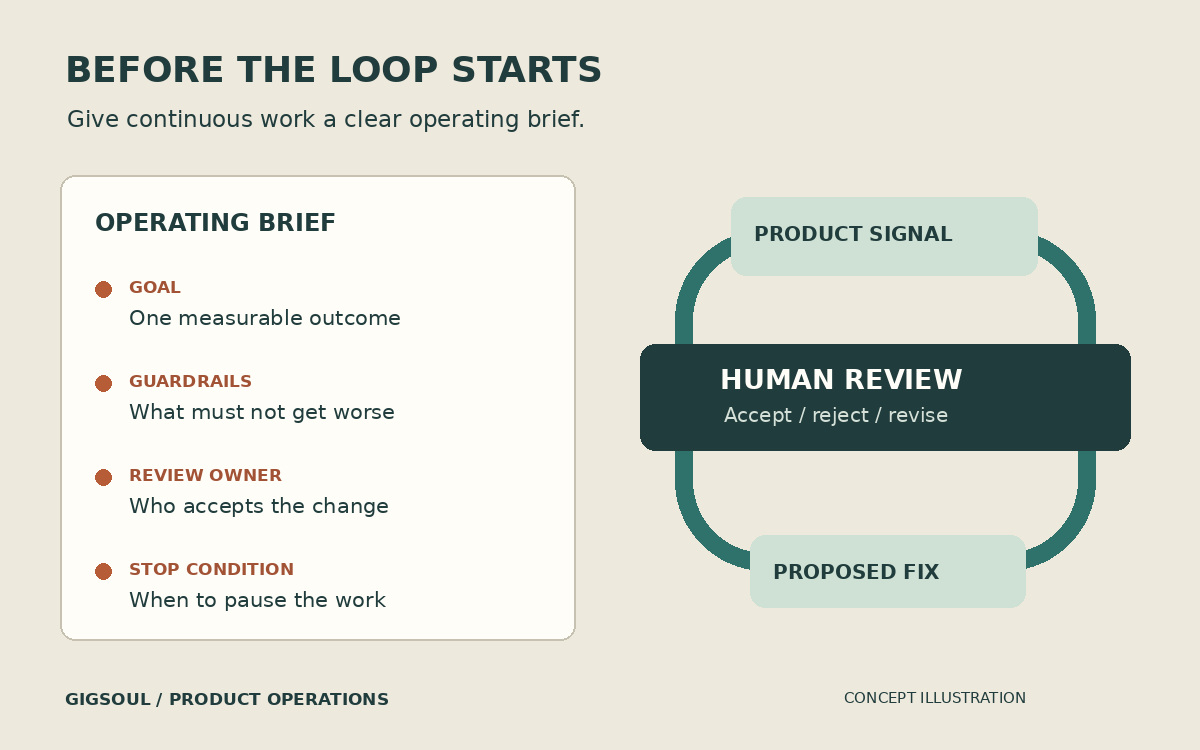
Original GigSoul concept illustration: an operating brief defines the goal, guardrails, review owner and stop condition for continuous product work. Not a product screenshot.
A coding agent can finish a task. A product metric can keep moving for months. Google is trying to connect those two clocks with Stitch Loop, a Google Labs experiment announced November 18 that watches product context, proposes changes and opens pull requests.
The interesting shift is who chooses the next task. Instead of waiting for a developer to describe a bug, Loop is meant to find work against an ongoing goal. For a small team, that could turn a neglected maintenance list into a steady queue of proposed fixes. It could also turn a vague objective into a very busy review queue.
My first step would be to write a one-page operating brief before connecting the repository. The hard part is deciding what a better product means, who can approve a change and what would make the experiment stop.
What Google actually announced
Google describes four stages: suggestions grounded in product evidence, solutions with tradeoffs, a build in an isolated cloud sandbox, and reflection against live data. You choose a direction before the build; the output is a GitHub pull request. Google says nothing merges until you review it.
The inputs include GitHub, logs, user behavior and feedback. Google advertises more than 180 integrations, custom MCP servers and CLI uploads. Built-in loops cover security, latency and accessibility; teams can add goals such as improving checkout conversion. The agent is meant to keep watching after a goal is met, in case the metric slips.
This is an experiment with a global waitlist, not a tool every reader can use immediately. Google says eligible AI Ultra users get priority access. This article is an analysis of the announcement and published coverage, not a GigSoul hands-on test.
The brief I would give an always-on agent
Consider a hypothetical signup flow. "Improve conversion" is too loose. A change could increase completed signups while also increasing unwanted accounts, support requests or friction for people using assistive technology. A useful brief gives the agent a target and gives the reviewer reasons to reject a superficially successful result.
- Define the measure. State which event counts as a completed signup, which users are in scope and the baseline period. A missing event should not look like an improvement.
- Name the guardrails. Keep error rate, page speed, accessibility and an appropriate quality measure visible beside conversion. These are constraints on the proposed work, not optional cleanup.
- Limit the first change. Start with a small, reversible surface. Keep billing, authentication policy and destructive data changes outside the initial scope.
- Assign the decision. Name the reviewer, the checks that must pass and the person who can roll back. Cap the number of concurrent proposals so the queue stays reviewable.
- Set a stop condition. Pause when evidence is missing, a guardrail worsens or the review queue exceeds the team's capacity.
That is an operator's suggested evaluation plan, not a claim that Loop exposes a setting for every item. Confirm the available controls before granting access.
A review promise needs repository rules
Google's human-review promise matters. I would still inspect the repository's actual permissions and merge requirements. GitHub's documentation explains how protected branches can require approving reviews and status checks. It also notes that administrators and roles with bypass permission are exempt by default unless the restrictions are applied to them too.
A reviewer should be able to follow the whole chain: the original signal, the reason for this fix, the code diff, the test evidence and the outcome after release. Screenshots can help explain an interface change. They cannot establish that a conversion metric improved because of it. Traffic changes, tracking changes and other releases can move the same number.
Early evidence, narrow conclusions
TestingCatalog's Alexey Shabanov reports using Loop for weeks on his site's theme, where it made small tweaks and suggested accessibility and compliance improvements. That is a useful concrete account of the kind of work it can propose. It is not a controlled result showing higher conversion, lower maintenance cost or comprehensive compliance.
The launch is worth watching because post-launch work rarely runs out. Before evaluating how much code an always-on agent produces, I would ask whether each proposal is easy to accept, reject and reverse. The scarce resource may turn out to be the team's attention. Give that a budget too.